
Infected wound management
Local infection, biofilm and critical colonisation: WUWHS assessment and antibiotic-sparing strategies.
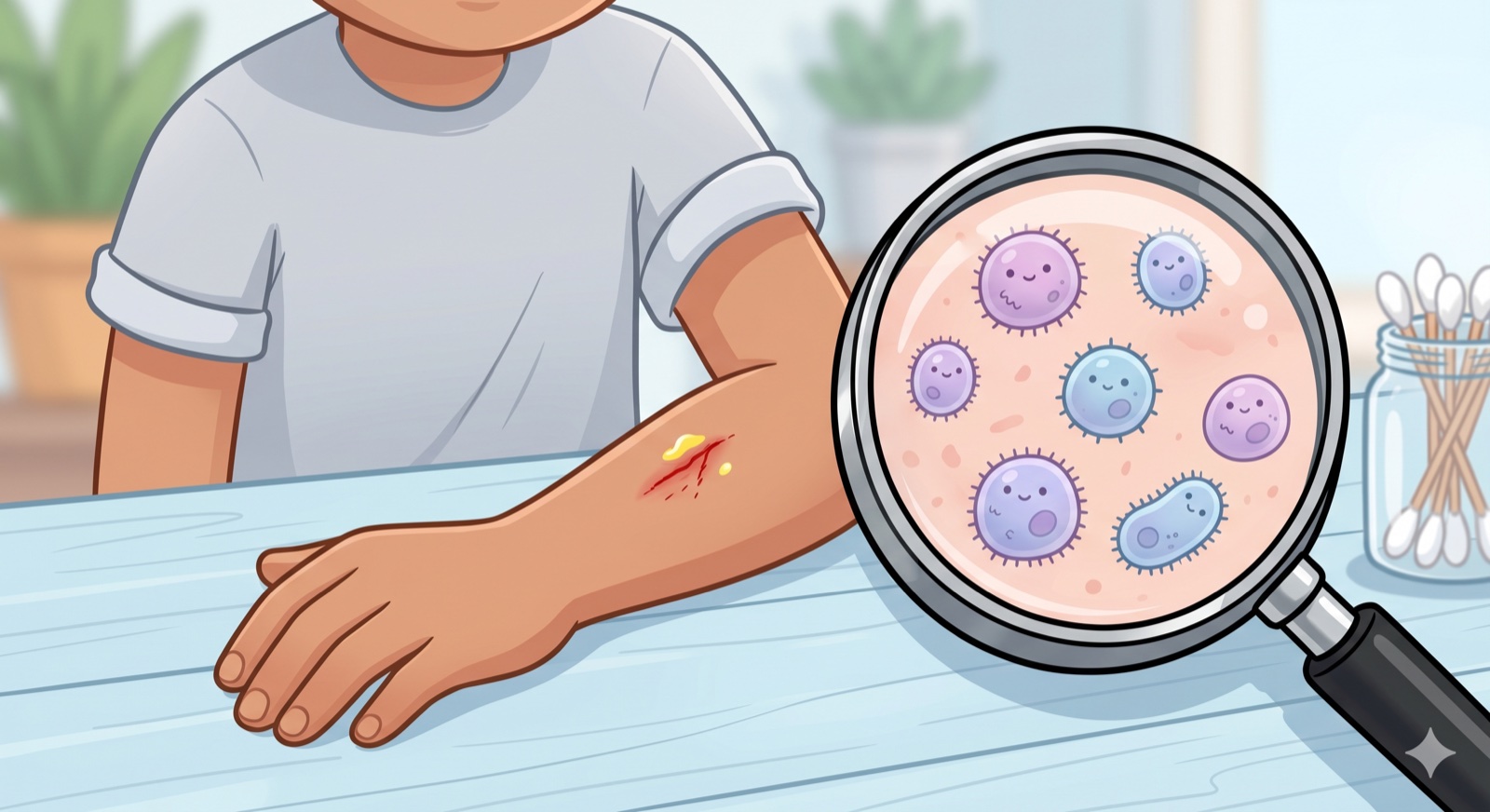
What it is
WUWHS (2019) defines wound infection as the host tissue's biological response to invading micro-organisms. The continuum is contamination → colonisation → local infection (including critical colonisation and biofilm) → spreading/systemic infection. Biofilm is present in 60–80% of chronic wounds and is resistant to most topical antimicrobials.
What it looks like in practice
3 real-world cases from clinics using Flaminal® — before/after photos, treatment protocol, and healing timelines.
Real clinical cases from the practice of partner clinics using Flaminal® in Uzbekistan. Patient personal data is not published.
Infection continuum (WUWHS)
Contamination
Micro-organisms present but not multiplying. No clinical signs.
Colonisation
Multiplication without harm. No treatment needed.
Critical colonisation / biofilm
Slowed healing, thin hypertrophic coating, increased exudate — without classic infection signs. This is where topical antimicrobials act.
Local infection
Erythema, oedema, local warmth, pain, purulent discharge.
Spreading / systemic infection
Cellulitis, lymphangitis, fever, tachycardia. Indication for systemic antibiotics and cultures.
Treatment principles
Surgical debridement
The most effective biofilm-disruption method. Should precede any topical antimicrobial therapy.
Topical antimicrobials
Enzymatic antimicrobial systems, povidone-iodine, octenidine- or PHMB-based antiseptics. 2-week course, then reassess.
Systemic antibiotics — only when indicated
Reserved for spreading or systemic infection. Empirical choice corrected by culture.
Reassess at 2 weeks
If the wound is not progressing — change strategy, biopsy, culture, and reconsider the diagnosis.
Flaminal®'s role
Glucose oxidase + lactoperoxidase generate hydrogen peroxide and thiocyanate that locally suppress microbial activity without driving resistance — useful for critical colonisation and biofilm when systemic antibiotics are not indicated.
Flaminal Forte
Heavy exudate.
Studies
Wound infection in clinical practice — international consensus
World Union of Wound Healing Societies · WUWHS · 2019
On requestBiofilms in chronic wounds — review of control approaches
Schultz G., Bjarnsholt T. et al. · Wound Repair and Regeneration · 2017
On requestFlaminal®'s enzymatic system and microbial-load control
Roos T., De Coster L. · Acta Chirurgica Belgica · 2018
On request
Further reading
More on the manufacturer's site
Flen Health maintains a detailed topic page with clinical cases. Opens in a new tab.