
Trauma care and emergency medicine
External bleeding control per STOP-the-Bleed and ATLS 10. Lacerations, abrasions, burns, penetrating limb injuries. From first aid to surgical revision.
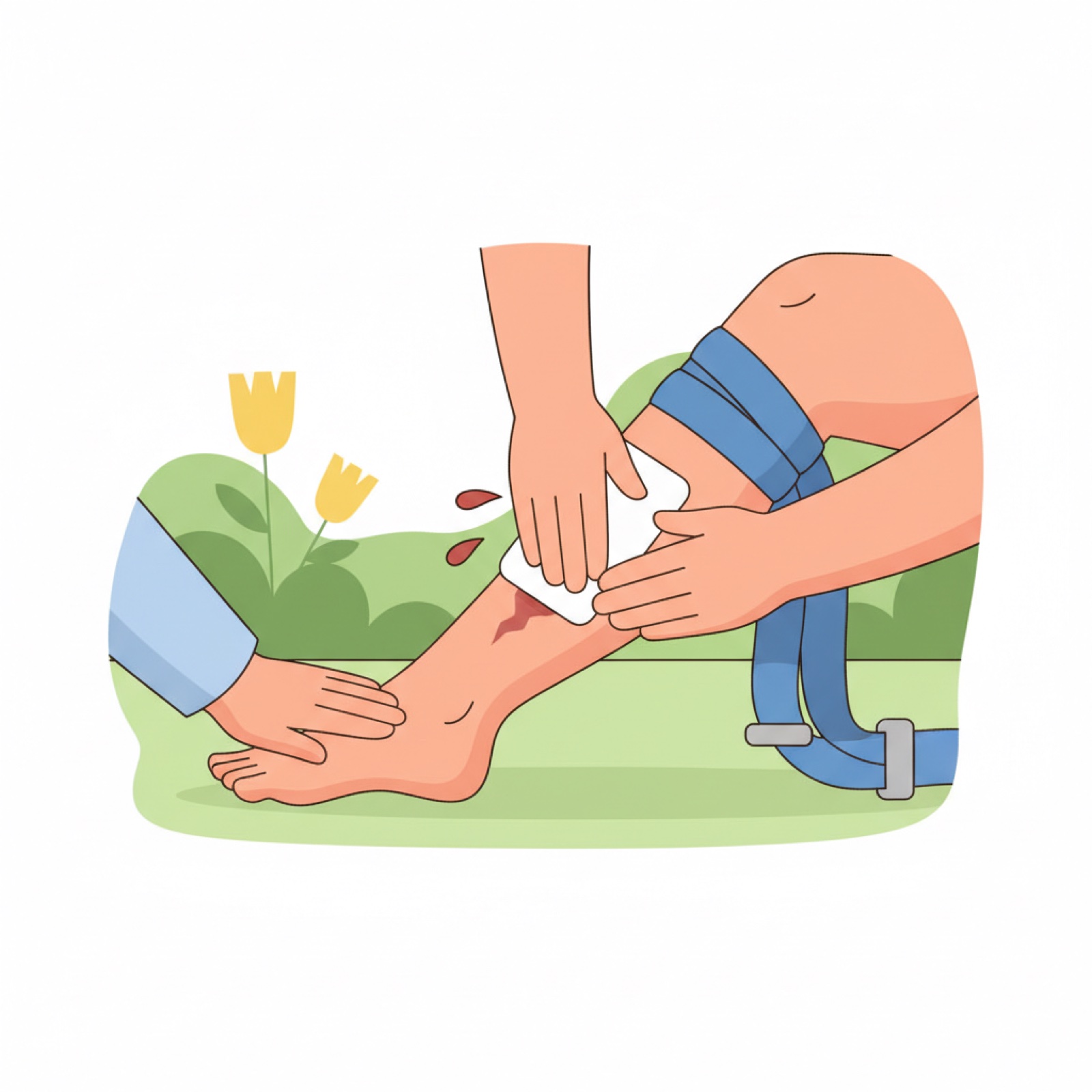
Traumatic bleeding
Bleeding is one of the leading preventable causes of trauma death. The Hartford Consensus (2013) established the principle that compressible external bleeding should be stopped on the scene — pushback against the older 'scoop and run' approach. STOP the Bleed (ACS, 2015) systematised three actions: direct pressure → tourniquet → wound packing with hemostat.
Hartford Consensus classification
Compressible
Limbs, superficial torso wounds. Direct pressure, packing, tourniquet all work. Target zone for STOP the Bleed.
Junctional
Axilla, groin, neck. Tourniquet not possible — only wound packing with hemostat and direct compression.
Non-compressible
Thoracic, abdominal, and retroperitoneal cavities. Pre-hospital options are limited — rapid transport to hospital is critical.
STOP-the-Bleed algorithm
Scene safety
Confirm scene safety. Put on gloves. Call EMS.
Find the source
Remove or cut clothing to see the wound. Pulsatile bleeding is arterial; slow dark red is venous.
Direct pressure + packing
Press dry BloodSTOP iX® 10×5 cm or 10×20 cm into the wound, packing the cavity to skin level. Hold compression for 3–5 minutes without releasing.
Tourniquet or pressure bandage
For arterial limb bleeding — tourniquet proximal to the wound (CAT, SOFTT, improvised). Record the time. Cover with a pressure bandage.
BloodSTOP iX®'s role
BloodSTOP iX® is designed for packing compressible wounds — the core method of STOP the Bleed after direct pressure. Compared to plain gauze it creates an active hemostatic barrier in 2 minutes rather than just a mechanical block. Contains no kaolin — no exothermic reaction or thermal burns described for some chitosan-based agents. Can stay in the wound until definitive surgical revision.
BloodSTOP iX 10×5 cm
Standard size for most limb lacerations and stab wounds.
BloodSTOP iX 10×20 cm
Junctional bleeding, large wounds, packing of groin and axilla.
Clinical guidelines
Hartford Consensus IV — Bleeding Control on the Scene
Jacobs L.M. et al. · Bulletin of the American College of Surgeons · 2016
ATLS 10th edition — external bleeding management
American College of Surgeons · ACS Trauma Programs · 2018
On request
Further reading
More on the manufacturer's site
LifeScience Plus maintains a detailed topic page with clinical cases. Opens in a new tab.